Curacao Non GamStop Casinos: GCB Licensing & Key Figures
Curacao non gamstop casinos are offshore gambling platforms regulated by the Curacao Gaming Control Board rather than the UK Gambling Commission.Read moreRead less
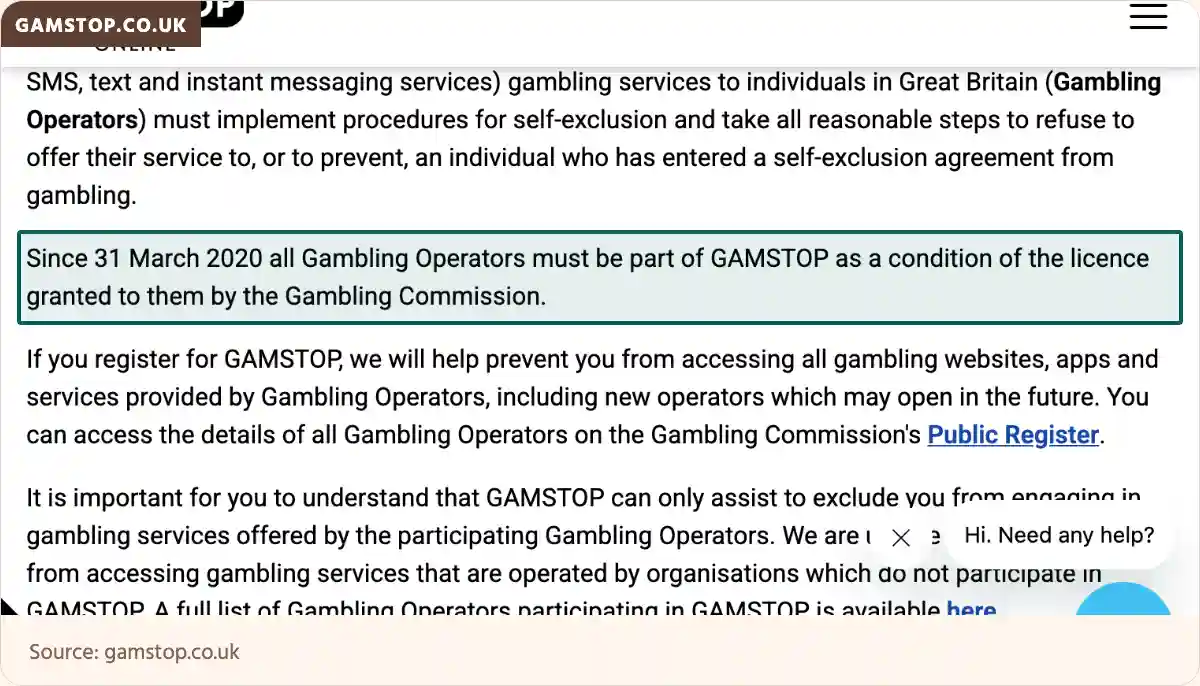
Since 31 March 2020, only operators holding a British licence must participate in the national self-exclusion database. Consequently, Caribbean-permitted venues operate outside UK regulatory jurisdiction and follow separate corporate, banking, and verification standards.
By Daniel Clarke · Mobile casino writer · Updated 2 November 2026
Curacao non gamstop casinos account for most offshore sites accepting UK play
Caribbean-permitted operators represent the largest segment of offshore platforms accessible to British residents because the Curacao framework covers casino, lottery, and sportsbook products under one permit.
Screenshot of gamstop.co.uk; the box marks the quoted passage. Accessed 4 November 2026.
Single overseas permit covering slots, table games, and sports betting verticals.
No technical integration with the British GamStop self-exclusion database.
Corporate registration maintained within the jurisdiction of Curacao.
Account verification governed by Caribbean anti-money laundering statutes.
Every domestic gambling business licensed by the Gambling Commission has been required to integrate with the GamStop network since 31 March 2020. Because curacao casinos accepting uk players do not hold a British operating permit, they remain curacao casinos not signed up to gamstop. That structural separation explains why curacao casinos not regulated by gamstop process registrations independently of The National Online Self Exclusion Scheme Limited.
In the United Kingdom, the Gambling Commission confirms that customer gambling winnings face 0 tax, as duty is charged strictly on operator gross yield. When comparing offshore venues, reviewing our overview of best non-GamStop casinos in the UK helps clarify how foreign licensing affects player recourse.
Direct GCB permits replaced the four legacy Curacao master licences
The Curacao Gaming Control Board abolished the historic sub-licensing system, replacing the four legacy master licence holders with direct state-issued operating permits.
Licensing Parameter
Legacy Master Sub-Licences
Direct GCB Permits (LOK Framework)
UKGC Operating Licence
Issuing authority
Four private master licence holders
Curacao Gaming Control Board
UK Gambling Commission
Direct regulator audit
Delegated to private master holders
Conducted directly by the GCB
Enforced by the Gambling Commission
AML threshold enforcement
Managed via master holder terms
Statutory Caribbean AML reporting rules
Strict UK financial crime compliance
Digital seal verification
Static or third-party validator seals
Dynamic colour-coded GCB portal seal
Public UKGC licence register link
GamStop connection
Not connected to GamStop
Not connected to GamStop
Mandatory since 31 March 2020
Under the Landsverordening op de Kansspelen reform, every offshore operator must apply directly to the regulator rather than leasing credentials from private master holders. By contrast, a British licence requires mandatory adherence to domestic consumer protection rules and a minimum 6 months self-exclusion option through GamStop.
Comparing the three regulatory tiers shows that only a UKGC licence grants access to the statutory 6 months to 5 years national exclusion framework.
Dynamic orange and green GCB seals show live permit status on operator footers
The Curacao Gaming Control Board issues encrypted digital seals in website footers that display an orange or green indicator depending on the operator's regulatory standing.
A green seal confirms a fully granted direct permit, whereas an orange badge signifies a transitional certificate while the board completes final compliance checks. As the Gambling Commission advises checking that any gambling business displays valid licensing details before you play, clicking the seal verifies whether the domain matches the official registry.
New Curacao licensing rules require stricter corporate audits at offshore casinos
The reformed Curacao licensing framework mandates that casino companies register a local corporate entity, disclose beneficial ownership, and submit to ongoing financial solvency audits.
Regulators require operators to segregate player balances from operational accounts and maintain verifiable compliance officers before receiving a direct permit. The Gambling Commission warns that unlicensed sites often lack secure payment systems, age checks, and responsible gambling tools, creating serious data protection concerns and risks of identity theft. Evaluating how a reputable non-GamStop casino documents its corporate registration and audit compliance reduces exposure to unverified operators.
Curacao non gamstop casinos support both fiat cards and crypto with distinct limits
Curacao non gamstop casinos process both traditional fiat bank cards and decentralised cryptocurrencies, applying different transaction minimums, payout caps, and clearance speeds to each channel.
Currency Type at Curacao Sites
Minimum Deposit (£ Equivalent)
Maximum Single Payout (£)
Average Clearance Time
Visa / Mastercard Fiat
Standard card processor entry tier
Capped per daily or weekly cashier rule
Subject to acquiring bank settlement days
SEPA / International Bank Transfer
Higher threshold due to wire fees
Structured for larger account balances
Multi-day international clearing cycle
E-Wallets (MiFinity / Jeton)
Low digital wallet deposit entry
Mid-tier single transaction ceiling
Processed after internal cashier approval
Bitcoin / USDT Crypto
Network fee dependent minimum
Higher ceiling than fiat card rails
Settled following blockchain confirmations
Under the Gambling Commission credit card prohibition, British-licensed operators must not accept credit card payments for gambling, whereas Caribbean rules leave card acceptance to the issuing bank and processor. Furthermore, the Gambling Commission notes that some unregulated sites block payouts or establish withdrawal thresholds so high they become unattainable. Players can compare full transaction terms on our guide to payment methods at non-GamStop casinos before funding an account.
While domestic UK regulations enforce a 0 credit card tolerance, offshore platforms differentiate clearance rules across four primary banking categories.
Independent testing labs audit RNG fairness across Curacao-licensed lobbies
Curacao-licensed casinos rely on accredited third-party testing laboratories to certify that their random number generators and return-to-player percentages meet technical fairness standards.
Before software suppliers can host slots or table titles under a direct GCB permit, independent auditors inspect the source code and mathematical payout models to prevent manipulation. Although the Gambling Commission states that British consumer protection rules only apply to domestically licensed businesses, checking studio-level RNG certificates helps verify software integrity across non-GamStop casino games.
Curacao AML regulations trigger mandatory ID checks on payouts outside GamStop
International financial crime directives compel GCB permit holders to verify account ownership and screen against sanctions lists prior to releasing funds. Meanwhile, the Gambling Commission highlights that unregulated platforms present heightened risks of fraud and identity theft when data handling controls are weak.
First-time cashouts require passport scans and recent utility bills
Compliance departments at Curacao-permitted casinos halt initial withdrawal requests until the account holder uploads a government-issued passport scan and a recent utility bill.
The cashier team cross-references the residential address and payment instrument ownership against the registered profile to prevent third-party transfers. Whereas GamStop enforces a minimum 24 hours cooling-off period before deactivating a finished self-exclusion, offshore KYC checks depend on document clarity and compliance queue times.
Dispute escalation under Curacao rules differs from the UK eight-week process
Resolving a player complaint under Curacao jurisdiction requires exhausting the operator's internal reconciliation process before submitting a report to the GCB portal, without access to UK-approved mediators.
Submit a formal written complaint to the operator's internal support desk first.
Retain all cashier logs, transaction timestamps, and promotional terms.
Wait for the internal resolution window specified in the casino terms.
Escalate unresolved licensing breaches via the official GCB online form.
Under British rules, the Gambling Commission states that a player must first complain to the operator and can escalate the dispute to a free Alternative Dispute Resolution provider after 8 weeks. UK ADR bodies do not accept customer service complaints and have no jurisdiction over curacao casinos not on gamstop. Readers can find further regulatory answers in our FAQ on non-GamStop casinos.
Checking the GCB registry number confirms whether an offshore casino holds a permit
Players can confirm whether an offshore site holds an active Curacao permit by cross-referencing the company registration number and dynamic seal URL against the official GCB register.
When users search for an instaspin casino license or verify another offshore operator, matching the footer certificate number against the public regulator database reveals if the permit is active or suspended. The Gambling Commission also runs a service to confidentially report suspected illegal gambling, though that portal does not process individual player complaints. Detailed breakdowns of permit verification appear across our non-GamStop casino reviews.
Overseas permits do not authorise gambling provision under domestic UK law
Under Section 33 of the Gambling Act 2005, providing gambling facilities to consumers in Great Britain without a UK Gambling Commission operating licence is a criminal offence.
The Gambling Commission explicitly states that a gambling licence issued in another country does not permit an operator to provide gambling in Great Britain, regardless of where the company is based. Anyone seeking free confidential support or counselling regarding gambling can contact the National Gambling Helpline (run by GamCare) on 0808 8020 133 at any time.
Questions we get most often
Why are Curacao non gamstop casinos not connected to the British GamStop scheme?
Participation in GamStop has been a mandatory licence condition solely for UK Gambling Commission operators since 31 March 2020. Because Curacao-permitted casinos do not hold a British operating licence, they have no legal or technical connection to the national self-exclusion database.
What is the difference between an old Curacao sub-licence and a new GCB direct licence?
Old sub-licences were leased from four private master licence holders with minimal state oversight, whereas new GCB permits are issued and audited directly by the Curacao Gaming Control Board. Direct licences enforce stricter anti-money laundering checks and display live orange or green verification seals.
How do I verify an operator licence number on the official Curacao GCB portal?
Scroll to the casino footer and click the official GCB digital seal to open the encrypted certificate page. Verify that the displayed website domain, corporate registration number, and green or orange status match the operator details.
Do Curacao-licensed casinos legally have to verify my identity before paying out?
Yes, Curacao anti-money laundering rules require operators to verify your identity, address, and payment method before releasing withdrawals. Players must submit a valid passport scan and a recent utility bill during their first cashout request.
Can I take a dispute with a Curacao casino to a UK-approved ADR provider?
No, UK Alternative Dispute Resolution providers only handle complaints against Gambling Commission licensees after an 8 weeks internal complaint period. Disputes with Curacao operators must follow the casino's internal procedure and the GCB reporting framework.